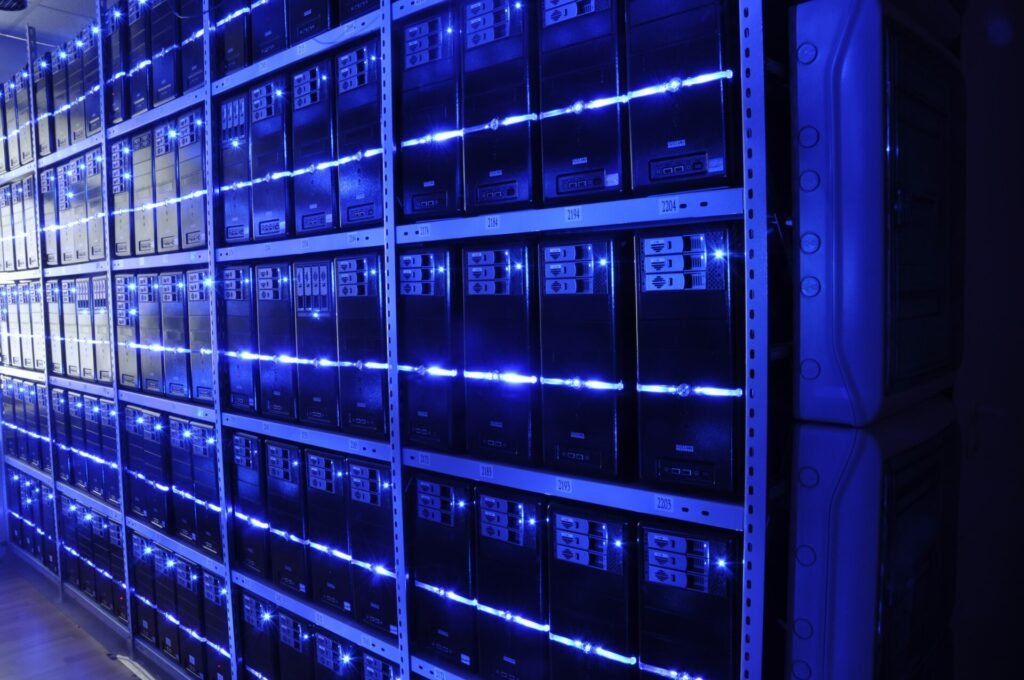
You cannot see it, but it is already running almost at full capacity in the debates. The new BRU01 data centre, built by the company KevlinX in Neder-Over-Heembeek, in the north of Brussels, will on its own consume around 3% of all the electricity demanded in the Region. The figure comes from the reply by Brussels Secretary of State for Energy Audrey Henry (MR) to a parliamentary question from MP Lotte Stoops (Groen).
140 GWh a year
In concrete terms, the first part of the site, completed at the end of 2025 and about to go into service, has a 20 MW grid connection. At that capacity, BRU01 should consume some 140 GWh a year, compared with the Region’s estimated electricity demand of 4,900 GWh in 2025 according to Brussels Environment.
To put it in perspective, and taking an average consumption of around 3,500 kWh per household as a rough guide, those 140 GWh correspond to the annual electricity use of some 40,000 homes. And this is only the beginning: grid operator Elia will release a further 20 MW from 2028 for the commissioning of a second phase.
How many data centres can Brussels absorb?
The Green MP does not question the technical quality of the project. She acknowledges an efficient design, with relatively little energy lost to cooling and water consumption in line with the sector’s own targets. But in her view, the overall pressure on resources remains significant, and the Region has no strategy for assessing projects of this kind.
Her question is simple: how many facilities of this kind can the capital absorb, and what investment in the grid will be needed? For reference, the Region’s total energy consumption, including gas and petroleum products, stood at 17,151 GWh in 2024.
AI driving a rush for data centres
The issue goes far beyond Neder-Over-Heembeek. Across Europe, the rise of the cloud and artificial intelligence is causing demand to soar for these server-packed buildings, which are heavy consumers of electricity and cooling. For cities, they represent investment and a form of digital sovereignty, but also direct competition for a power grid already strained by the electrification of cars and heating.
Between economic attractiveness and energy restraint, Brussels will have to decide. The BRU01 file could well become a textbook case.
Sources : La Libre / Belga
Photo: BalticServers.com / CC BY-SA 3.0, via Wikimedia Commons